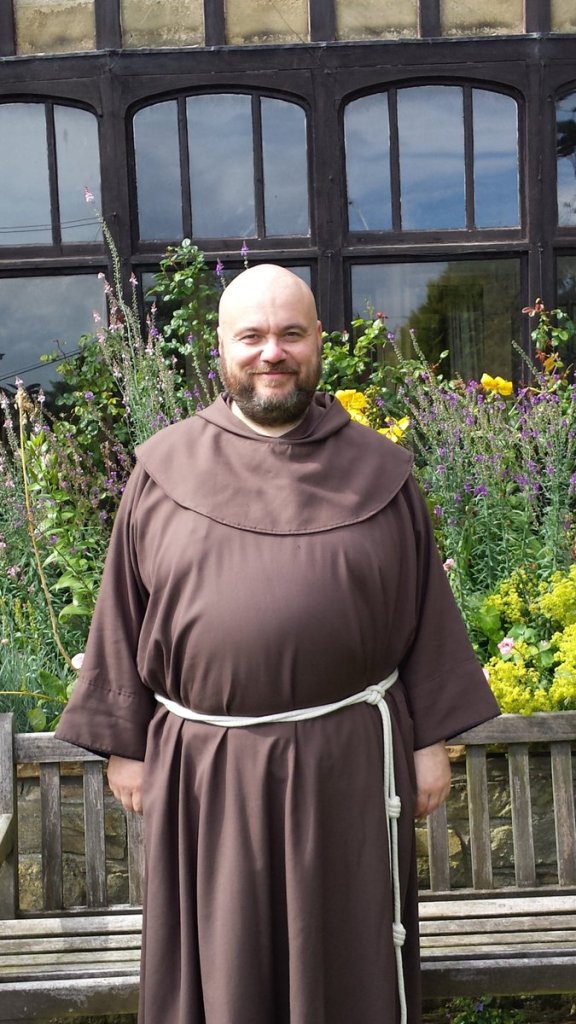
Franciscan Community – What’s the point?
(Talk given in St Mary’s Episcopal Cathedral, Edinburgh in 2015)
Introduction.
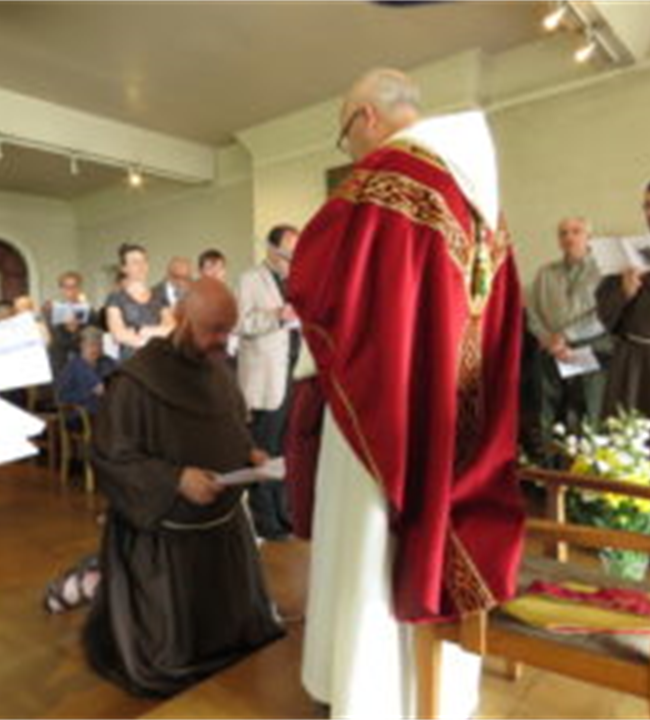
In less than a fortnights time a man will stand up in the Chapel at Alnmouth Friary and state his intention to enter the Novitiate of the First Order of the Society of St Francis – the Franciscan Order in the Anglican Communion. During that service he will indicate that it is his intention to join a Religious Community and – after a ‘sufficient period of probation’ – to live under the Traditional threefold vow of Poverty, Chastity and Obedience for the rest of his life. In so doing he will voluntarily give up any right to personal property; an exclusive emotional relationship and any right to assert control over the trajectory of his life. Despite the immensity of the undertaking he isn’t alone in choosing to take this step. In the five years since I joined the Community nine men have also taken this step. Ranging in age from mid-twenties to mid-thirties and from many different academic, social and vocational backgrounds we have all decided to take this step to follow Jesus in the steps of that most attractive – and puzzling – of the medieval saints, Francis of Assisi. Why? What makes Religious Life worthwhile in 21st Century Britain? What is the intrinsic quality (that is to say as opposed to the extrinsic ‘works’ dimension) which is important? Why are people still showing an interest in living this sort of life? Why, more specifically, do people want to walk in the footsteps of Francis?
Religious Life in the 21st Century
Before I begin to answer the question I need to make something abundantly clear and that is that, in no way, shape or form, should we think that Religious Life is the best way let alone the only way to be a disciple of Christ. The Principles of the First Order of the Society of St Francis – a document I will quote from more than once this evening – says this: “…In their relationships with those outside, the brothers and sisters must strive to show their Master’s humility…In particular they must resist the temptation to consider themselves superior to others… realising how much greater are the sacrifices and difficulties of those engaged in the ordinary professions of life and how much more nobly they face them…” Having said this there is no doubt, however, that Religious Life offers something ‘different’ from the norm (whatever that may be…) but why is it important in the 21st Century? One answer to that question – and it isn’t the only one – is to look at the three ‘traditional’ vows – also called the Evangelical Counsels – as being profoundly counter-cultural and having something Prophetic and challenging to say to the current zeitgeist.
The Principles tell us that the vows are embraced by those wishing to live the Religious Life because “they stand for the ideal of the perfect renunciation of the world, the flesh and the devil, which are the three great enemies of the Spiritual Life…” and in this sense we could see that the Religious Life – in itself – is a reminder of the Spiritual dimension of our existence; an aspect of life which is largely marginalised and side-lined in 21st Century Society. Archbishop Justin of Canterbury – in an as yet unpublished foreword to the 2016 Anglican Religious Yearbook – says that he supports anything which testifies to the reality of God in the world and that Religious Communities show – by their very existence – that they truly believe that this is the case for if they didn’t then the life they live – and choose to live freely – would be a complete and utter nonsense. We are, in one sense, the biggest gamblers going… This is on a purely Spiritual plane but I also believe that Religious Life can speak on a much more practical level into our 21st Century world: let’s look at the vows individually and see how they might do that.
Poverty
The vow of Poverty is something which demands a certain amount of explanation and before I do that I also need to stress that we need to draw a real distinction between Evangelical poverty; that is to say a Poverty which is freely chosen as a Religious act and the sort of material poverty we reflected on together yesterday when we remembered the homeless. The one is life giving and the other blights and stunts life to such an extent that we might say that it was – and this is a term used about poverty in Latin American Liberation Theology – a Sin.
Poverty in the sense we understand it as Religious does not mean that the quality of our lives is blighted as with those who are materially poor or that we have nothing in our rooms or in our Friaries or Convents; if you were to come into my room in the Friary you would see that I have books and Icons and things like that; my room is comfortable and well appointed and I have no worries about whether I will eat or not unlike an ever-increasing number of people in our country today. Instead, Evangelical Poverty is about adopting a mindset and a way of relating to physical possessions, a way which stresses that nothing is ‘mine;’ instead everything is ‘ours.’ The Principles say this: “…the brothers and sisters desire to possess nothing which cannot be shared by those around them and such things as will help to satisfy their needs…they receive no pay and own no personal possessions. They live as a family having all things in common. They receive for their use the simple necessities of life. Yet what the receive they regard not as their own but rather as lent to them for a season…”
Commenting on our current milieu the Polish Philosopher Leszek Kołakowski6 described what he called ‘the commodity fiction’ or ‘commodity fetishism’ in so doing he highlighted the fact that market forces are striving ever more aggressively to assert their absolute control over everything no matter on the impact such praxis may have on the weak and the vulnerable. Anything and everything, so it seems, can be bought and sold and owned and anything, so it seems, can be privatised but not for the good of the many, instead, for the benefit of the share holding few. It seems to me that here we have the antithesis of what Evangelical Poverty – the sense that all things are best held in common – is about. In that sense one might say that the answer Evangelical Poverty gives to the ‘world’ (that being the world in the Triad of world, flesh and devil) is to question the basic assumption that it is axiomatically ethical to assert one’s right to own any – and every – thing.
Chastity
The vow of Chastity also demands explanation. On one level it is often misunderstood because people imagine that it simply means that those who choose to live the Religious life choose to abstain from sexual activity. That is, of course, quite true but the vow of Chastity goes much deeper than the purely physical because it involves an acceptance that we are not called to an intimate relationship with another person on any level whatsoever whether physical or not. The Principles are clear, however, that this does not give a Friar or Sister a right to a sense of superiority “…[the brothers and sisters] do this not because they believe that the unmarried state is in itself higher than the married, but because they believe that for them the unmarried state is that in which God wishes them to serve Him…” The Principles then go on to note “…In thus accepting the state of chastity, the brothers and sisters must ever be on their guard against the temptation to self-centredness, coldness or a lack of sympathy with the interests of others. Their espousal to Christ must not weaken or mar their human affections. Rather must their union with him enable them to love more richly with his love all with whom they are brought into contact…” In that last quotation we see why Celibacy is deemed to be important to Religious: it does not limit one’s capacity to love, instead, it takes the love which might be offered to one person and allows that love – albeit in a different form – to be diffused to many. It is not about loving more or less but about loving differently.
In our world today a great deal of store is placed on one’s relationship status. Despite the incidence of single people increasing (1/3 of all adults are currently single) there is still a tendency to define oneself and to see oneself as being not quite complete without a ‘significant other’ (look at the expression!) or one’s ‘other half.’ This causes many people to experience sadness and depression; to look for ‘love’ in unwise, unsustaining and unsafe ways whether virtually or physically. Might it be the case that the Religious Life gently suggests that it is possible to live a happy, fulfilled, valuable and loving life without having a Spouse? Might it also remind us that to have a partner or spouse is not a right but a gift?
Obedience
If one were to ask me which of the vows I found hardest to keep there is no doubt that the vow of obedience would take some beating! I am not by nature an obedient person and like a lot of people I am headstrong and can be rather opinionated. Like even more people I like to be in control of my destiny… However, the vow of obedience requires that those who live under it give up all of this; not in the sense that we are not allowed to have an opinion (or for that matter to voice it) but that we try – as much as is possible – to hear the voice of Christ in what the Community asks us to do: “… The obligation of particular obedience within the community is gladly accepted by the members [discuss…] not as something different from the obedience which they owe God, but rather as part of that obedience…”10 This is not, however, unquestioning obedience, indeed, the Principles are quite clear that the individual conscience of the Brother and Sister should be the guiding principle. This is not about becoming an automaton, instead, it is about allowing ‘me’ to decrease in order that the good of the Community might be paramount.
In our world today great store is put in the concept of rights and in many cases rightly so; it is good that we are becoming ever more committed to protecting the basic human rights of our brothers and sisters especially when they are vulnerable. However, there are times when one’s rights are so strongly stated that it causes another to suffer and to diminish; little thought is given to the other. Instead, it is about my right to do what I want when I want to do it. Perhaps the vow of Obedience; with its sense of listening to others and thinking about the whole has something to say too? Perhaps it reminds us that the good of the many is, indeed, more important than the good of the few.
Franciscan Community
Thus far I’ve looked at Religious Life in general but I want – briefly – to address the notion of Community from a specifically Franciscan viewpoint. One of the wonderful things about Francis – and also one of the things which makes assessing his contribution to the Church so difficult – is his popularity which has, in turn, elicited a truly staggering number of books and articles many of which – one suspects – attempt to make Francis into the image and likeness of the author and therefore not surprisingly make Francis a spokesperson for those things which the author holds dear him or herself. What is clear from the Primary Sources – of which there are many – is that Francis did not actually intend to form a Religious Community. That he did so came as a complete surprise to him although he was, thankfully, rather more gracious about the men coming to him than some of the Egyptian Desert Fathers who continually tried to run away from would-be adherents. God, in His Providence, had different ideas for Francis and by the time the Saint died the Order had grown hugely, so much so that over 3,000 Friars attended the First Chapter of mats in Assisi in 1221. That they were representing groups of Friars shows quite how large the Order was and how dramatically the order had grown in the twelve years between 1209 (when Francis decided to live out the Religious Life in his own context) and 1221. Whether Francis intended to form an order or not he did and three words can be applied to the underlying ethos of all Franciscans which are: Community, Fraternity and Minority. They are, in fact, a version of the name by which the original Franciscan Community – the Order of Friars Minor – was and is known in the Roman Catholic Church. These three concepts are intrinsically linked to the three vows and in that sense are common to all who live the Traditional Religious life but, nonetheless, they are the animating principles of Franciscanism – our ethos – and are therefore more strongly apparent in the Franciscan movement than in any other. How might they speak to the word in a uniquely Franciscan way?
Community
In talking about the vow of Obedience a few moments ago I suggested that there is a tendency in our 21st Century World to exalt the individual over the corporate. The words of a certain British Prime Minister recently deceased exteriorise this mindset perfectly: “there is no such thing as Society…” Franciscanism questions that very strongly indeed. In our living as a Community we recognise that we are dependent on others, that others are dependent on us and that that is right and good. There is a reciprocity; a complementarity which we reflect to the world. ‘No man is an Island’ said John Donne and so do Franciscans; we need each other; we are diminished if we think we can (or should) function on our own.
Fraternity
We affirm this interconnectedness, however, not because it is merely a good thing or a socially kind thing to do; we live with this extended consciousness; this sense of the matrix of human existence because we believe in Fraternity; the fundamental relatedness of each and every person with each other and with Creation itself. Many Brothers and Sisters united under the One Heavenly Father. In many Religious Orders (at least male Religious Orders) there is a sharp distinction drawn between Priests and lay brothers. Not so in the Franciscan Tradition: we are all called Brother and, in the earliest days of the Franciscan movement not only were the Brothers called Brother but everyone with whom they interacted was called Brother or Sister and not merely as a courtesy or an honorific but because that sense of fraternity (I apologise that there isn’t an inclusive word) was felt to be of God and essential. In affirming that interconnectedness we personalise the other; we accept that their happiness and wellbeing has an impact on our happiness and wellbeing. I cannot function fully if my brother or sister is unable to do likewise. If my Brother or Sister can not function properly and fully because of poverty or the greed of others or because he or she is exploited or discriminated against because of his or her colour, religion, sexuality or financial status it is incumbent upon me; because they are my Brother or Sister and therefore precious to me to do something to help them.
Minority
These are grand ideals; rather like the concept of the Bodhisattva in Buddhism but, thankfully, we don’t set our aspirations too high and this is where the last of the three Franciscan words comes into play and that word is, of course, minority – smallness, insignificance. We do not seek to do great things (like Francis). Instead, our one hope is that we are faithful to God and faithful to the life to which He has called us and is calling us. If in the course of living that life we can benefit one person and lead one person towards the unquestioning love of Christ then we will have done our job. In real terms the Society of St Francis is a small and shaky body of men: in this country there are only 36 Friars the majority of whom are old and the reality of the situation is that we will get smaller. We want to open new works and want to staff the ones we have adequately but it is a perpetual struggle for those in charge of the Order. That that is the case is, on one level, not a bad thing because it reminds us that our task is not grandiose. Instead, it is to live in simplicity, in love of all people and of the world. We do what we can and not what we can’t.
Franciscan living outside Community
Living this life is all very well if, like me, you aren’t married and don’t have a family to worry about. How can these insights; both the insights of the three vows and the concepts of Community, Fraternity and Minority be translated into the warp and weft of wider human existence? The most obvious answer to this question is the one which Francis himself gave when he formed the Third Order which allows men and women, married and single to inculturate these Franciscan insights into the context of their own lives whilst being sustained by Brothers and Sisters and there are Tertiaries here in this very congregation; think about it! But here are a few suggestions (and maybe we can discuss this at greater length in a moment) which anyone if they are so minded could think on.
I said that the vow of poverty was primarily about acknowledging that possessions are not integral to happiness. This doesn’t mean that we shouldn’t own things (or enjoy owning them) but perhaps the way we approach ownership and the spirit in which we pursue property and possessions is something which we can adjust? Similarly, it is right and wonderful that the majority of people live in married (or partnered) happiness but maybe we need to re-acknowledge that all relationships and especially relationships of this sort are a gift and not a right? Maybe the way we love could be a little more inclusive – taking into account the lonely, the unloved and the unlovable without neglecting the particular relationships to which we are called? The concept of Obedience is, at it’s most fundamental, about acknowledging that there might be something more important than what I want or what I think is right. Instead, it encourages us to think about the other; to think about the greater and corporate good. It eschews the notion that individual thriving at the expense of the other is good and instead causes us to look at the thriving of the whole; at the thriving of the Community. Like Community and Fraternity as the ‘animating principles’ of Franciscanism perhaps we all need to move away from individualism and make political, social and individual choices which speak of a greater awareness. Lastly, minority: very simply, we need to do what we can and not worry about what we can’t!
Joseph Emmanuel is the Novice Guardian for the Society of Saint Francis, in the European Province. If you’d like to discuss your sense of vocation to the Franciscan way of life feel free to email him at: noviceguardianssf@franciscans.org.uk
 Vocational Stories into Anglican Religious Life